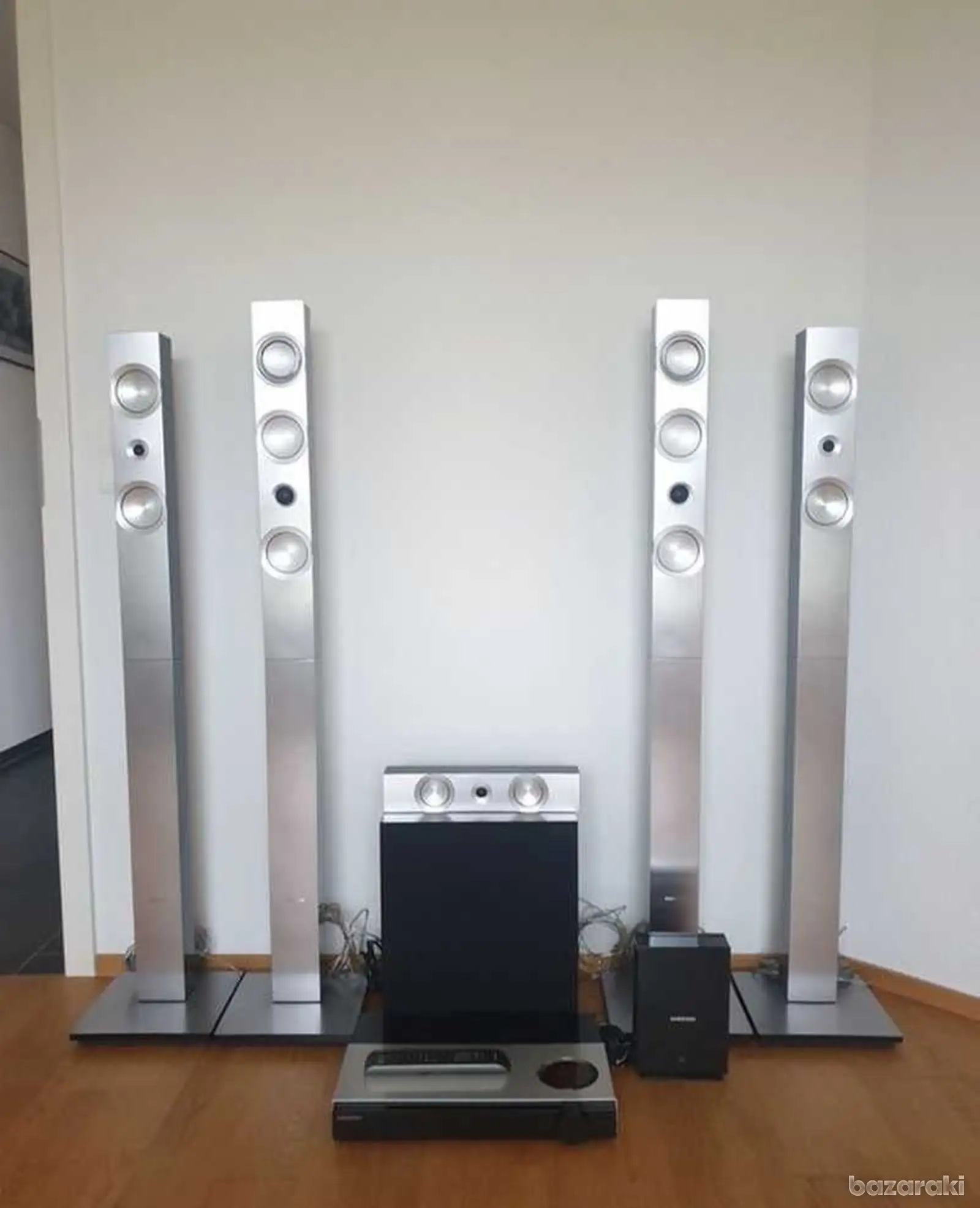
Samsung ht-f9750w home theatre.
Blu Ray with 4k upscale. Surround sound 5.1/7.1ch: 2 front speakers (with 2 front top speakers), 1 central speaker, 2 back surround speakers, 1 subwoofer.
Samsung HT-F9750W - flagship system from 2013
A rare system even by today’s standards, where many things were done “the proper way”:
• GaN amplifier + vacuum tube
The output stages use Gallium Nitride (GaN) transistors instead of conventional silicon. GaN switches significantly faster, has lower switching losses, performs better at high frequencies, and offers higher thermal stability.
Rated bandwidth on the digital input is 20 - 40 kHz (±4 dB). Even though humans don’t hear above 20 kHz, this headroom provides a more linear phase response in the audible range, faster transient response (impacts, clicks, breaths), and lower distortion. The amplifier simply “doesn’t struggle” at the edges of the working band.
The preamplifier uses vacuum tubes (similar in character to 12AX7). They add characteristic even-order harmonics, soften the harshness of the digital stage, and deliver more natural, “alive” midrange.
Result: a combination of GaN’s speed, low distortion and wide bandwidth with the warmth of tubes.
GaN transistors are still noticeably more expensive than silicon MOSFETs. For mass-market soundbars and budget systems the cost difference isn’t justified — it’s cheaper to use a regular silicon Class D amplifier and compensate for its shortcomings with heavy DSP processing. GaN is mostly found in higher-end hi-fi and professional gear.
• True physical 7.1 channels
Seven separate speakers + subwoofer. Sound comes from real directions, not created by algorithms from a single enclosure.
Result — much more precise soundstage, better instrument separation and genuine surround. Modern soundbars in this price range almost always rely on virtualization.
• Another significant advantage — CPID diaphragms (Ceramic Polypropylene Injection Diaphragm)
Rigid yet lightweight cones hold their shape better at large excursions.
This delivers cleaner and more detailed sound, especially at medium and high volumes, without muddiness or blurring. In modern inexpensive systems the focus is more often on DSP correction rather than the quality of the drivers themselves.