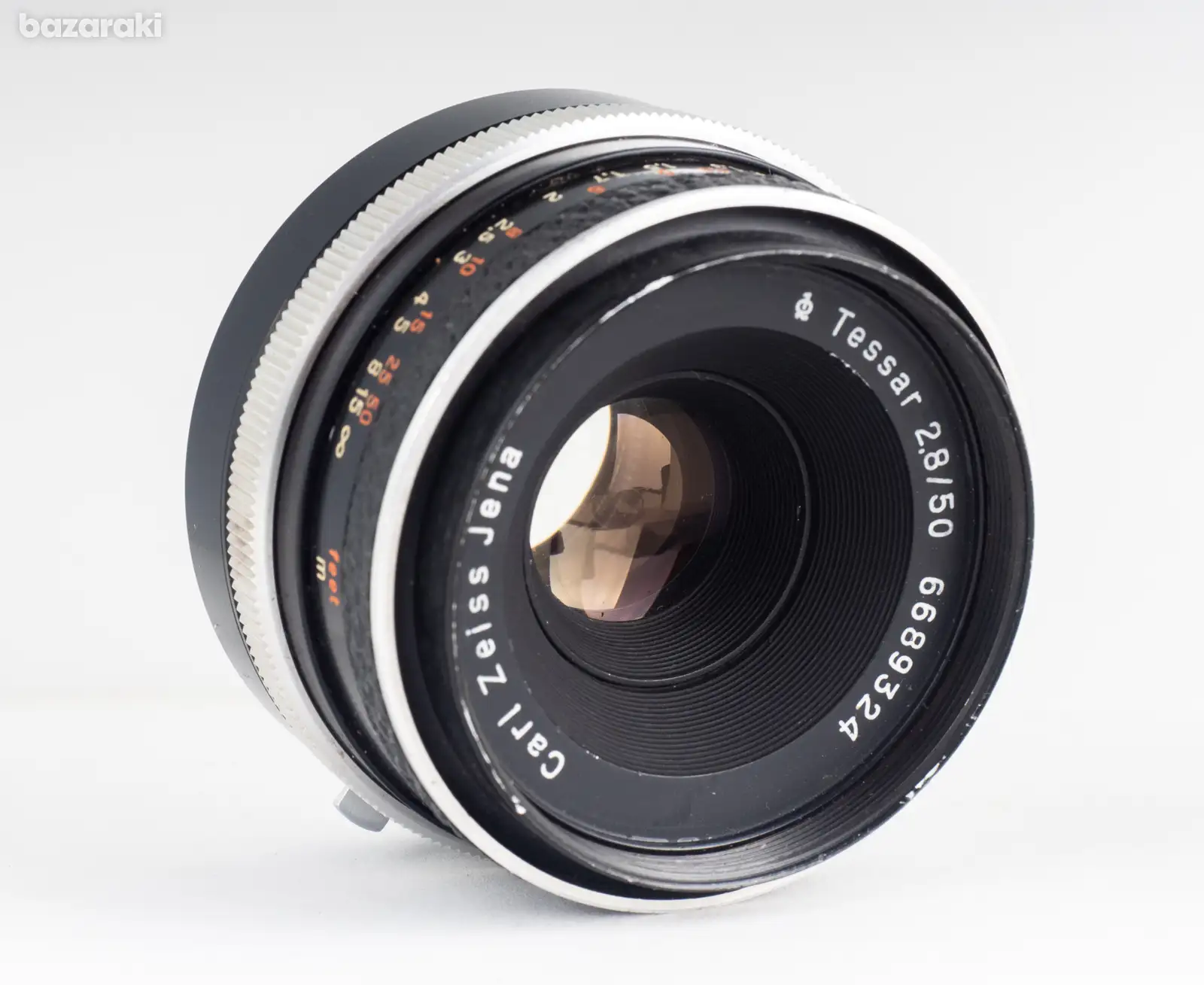
Carl zeiss jena tessar 50mm f/2.8 zebra 1q- quality m42 vintage prime lens
Σήμερα
4
1 / 7
Κατάσταση:
Μεταχειρισμένο
Περιγραφή
Μετάφραση σε:
F2
The Carl Zeiss Jena Tessar 50mm f/2.8 is one of the classic East German Zeiss standard lenses and remains highly appreciated for its compact construction, strong contrast, excellent central sharpness and distinctive vintage rendering.
This particular example features the highly attractive “Zebra” design, with alternating black and silver rings that have become especially recognizable among collectors and vintage-lens photographers.
The Tessar optical formula is one of the most famous designs in photographic history. Originally introduced by Zeiss in the early 20th century, its efficient 4-element construction became known for producing very good sharpness, strong contrast and low distortion. This reputation helped give the Tessar family its famous “Eagle Eye” nickname.
What makes this particular lens even more desirable is the presence of the prestigious “1Q” (First Quality) mark. This was an official quality designation used in the former DDR and was reserved for production that passed especially strict quality-control requirements. Products carrying the 1Q symbol were associated with the highest official quality category and were intended to meet the demanding standards of international export markets.
For collectors, this detail is especially important. A Carl Zeiss Jena lens with the 1Q mark identifies the lens as coming from production certified to the manufacturer’s highest official quality class of the period. Because of this, 1Q-marked lenses are particularly desirable among collectors and enthusiasts, especially those searching for the more prestigious export-quality examples.
The lens uses the versatile M42 screw mount, making it suitable for many classic M42 film cameras and also very easy to adapt to modern mirrorless systems such as Sony E, Fujifilm X, Canon RF and Nikon Z with the appropriate adapter.
It offers a classic 50mm focal length with an aperture range from f/2.8 to f/22, making it an excellent choice for general photography, street photography, portraits and photographers who enjoy the distinctive character of vintage Zeiss glass.
The focusing scale includes markings in both meters and feet, and the lens focuses down to approximately 0.35 m, making it surprisingly useful for closer subjects as well.
Condition
The lens is in excellent overall condition for its age.
There are some normal cosmetic imperfections and signs of previous use on the body and around the front outer ring, all clearly visible in the high-definition photographs.
The classic black textured grip section is intact, while the aperture and distance markings remain clear and easy to read.
Optically, the lens is in excellent condition, with clean glass and no fungus or haze.
The aperture blades are clean and open and close correctly throughout the aperture range. The aperture ring operates smoothly, and the manual focusing mechanism is smooth and comfortable to use.
The M42 rear screw threads are in good condition, and the mechanical aperture pin is present.
The lens has been fully tested and is working correctly.
A particularly attractive example of the classic Carl Zeiss Jena Zebra-era Tessar, combining historical importance, the highly desirable 1Q First Quality marking, compact construction and the distinctive photographic character that continues to make these lenses popular with both collectors and photographers today.
Seller’s Note Regarding Vintage Lens Focusing
Please note that when describing a vintage lens as having smooth focus, this means that the focusing mechanism operates within a normal and practical range that allows the photographer to use and focus the lens comfortably.
Vintage manual-focus lenses can vary considerably in resistance because of their age. Some older lenses lose part of their original resistance and become slightly looser, while others can become somewhat firmer as the original focusing grease dries over the years.
A slightly firmer or looser focusing movement can therefore be completely normal for a vintage lens and does not necessarily indicate a fault. This particular lens remains within a normal and usable focusing range, and the focusing mechanism operates correctly.