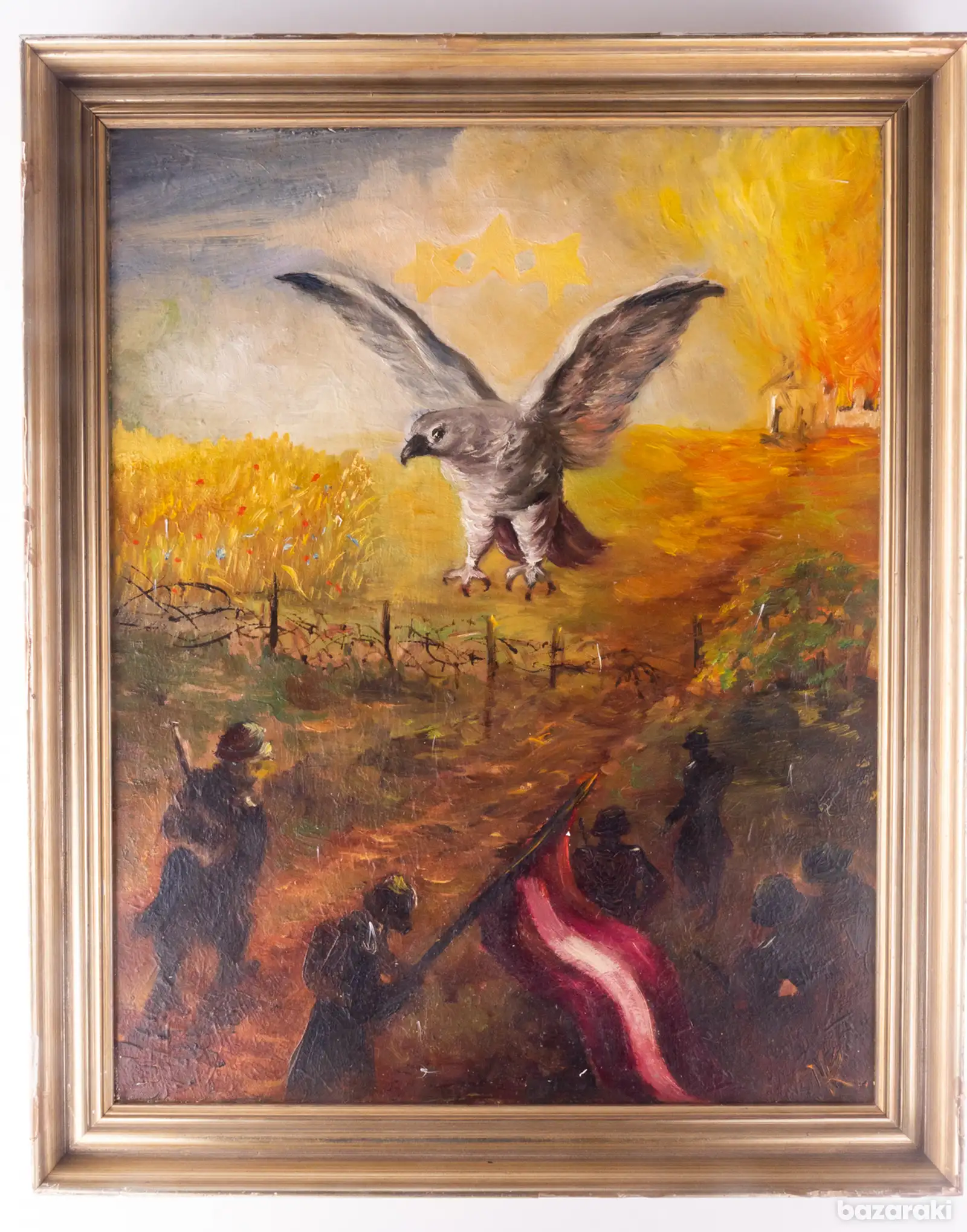
Rare latvian exile oil painting - esslingen, germany c.1955-1960
4 weeks ago
111
1 / 15
Condition:
Used
Description
Translate to:
Historically Researched Post-War Baltic Exile Artwork with Original Inscriptions
Executive Summary
Offered for sale is an original oil on canvas painting, framed size 38 × 46 cm, believed to originate from the Latvian exile community in Esslingen, Germany, during the late 1950s to early 1960s.
Beyond its artistic value, this work carries significant historical importance, preserving handwritten Latvian inscriptions, post-war German materials, and documented research connected to the Latvian refugee community after the Second World War.
While the artist remains unidentified, the painting has been independently examined by Latvian researchers, museum specialists, and senior curators, contributing to its historical and cultural significance.
Provenance & Inscriptions
The reverse of the painting preserves two original handwritten Latvian inscriptions:
1. Wooden Frame Inscription (1960)
A personal dedication from a woman named Vera to a man named Ansis, marking his 50th birthday on 1 November 1960. The message expresses warm personal sentiments and long-standing friendship.
2. Canvas Inscription (1963)
A second inscription records that the painting was presented in Esslingen, Germany, in 1963 as a birthday gift to a person named Artis (possibly Artūrs).
These inscriptions strongly suggest the painting circulated within the Latvian exile community in Esslingen during the early 1960s.
Historical Research & Expert Opinions
The painting has been reviewed in correspondence with Latvian art historians, museum specialists, and curatorial experts.
One interpretation (Dr. Kristiāna Ābele, Latvian Academy of Art) places the work within the context of Latvian exile artistic culture in post-war Germany.
Another independent opinion (Guna Dancīte, Museum of Latvians Abroad, Riga) suggests a possible connection to Ansis Pļočmalis (b. 1910), based on the exact birthday date recorded in the painting (1 November 1910), which corresponds precisely with the “50th birthday” inscription. According to this interpretation, Pļočmalis served in military forces during the Second World War and later remained in Esslingen, where he was active in the Latvian exile community and reportedly served as chairman of the Daugavas Vanagi organization in Esslingen for approximately ten years.
This interpretation is further supported by symbolic elements in the painting, including a hawk and three stars, which are associated with the Daugavas Vanagi veterans’ organization.
The identity of “Vera,” who authored the dedication, remains uncertain and may have been a friend, relative, or possibly connected to the Latvian women’s auxiliary organization “Daugavas Vanadzes.”
Importantly, this attribution has also been supported by additional expert feedback from Inese Baranovska, Head of the Latvian Decorative Arts and Design Department at the Museum of Decorative Arts and Design (Riga), who confirmed that the painting is very likely connected to the Latvian exile community in post-war Germany, reinforcing the overall interpretation of its cultural and historical context.
This remains a well-supported but not yet conclusively proven interpretation based on current available evidence.
Symbolism
The painting contains strong Latvian national and exile symbolism, likely reflecting themes of loss, resilience, and remembrance:
A descending hawk/eagle beneath three stars
Latvian figures carrying the national flag
Barbed wire symbolizing occupation and captivity
A burning farmhouse representing wartime destruction
Golden fields suggesting hope and homeland memory
Some elements may also reference symbolism associated with the Daugavas Vanagi organization.
Materials & Authenticity
Several physical characteristics support the painting’s post-war origin:
Original oil on canvas
Canvas stamped “Viktoria Maltuch – A. Schutzmann” (post-war German manufacturer)
Factory size stamp “38” (European standard format)
Paper label from Kunsthandlung Eugen Köder, Berkheim & Esslingen
Original iron nails used in stretcher construction
Natural age craquelure consistent with decades of ageing
Original period frame with expected wear
Two original handwritten inscriptions in Latvian, including names, dates, and location (Esslingen, Germany), documenting the painting’s movement within the Latvian exile community during the early 1960s
Condition
Very good vintage condition.
The canvas remains stable and structurally sound, with natural craquelure across the surface consistent with age. The original frame shows expected wear, further supporting its authenticity and historical character.
Please review all photographs carefully as they form part of the description.