16
A Little Edwardian Handbag and the Story Behind Its Beads
The story of this little handbag begins more than a hundred years ago, around the beginning of the twentieth century, when beautiful things were still made slowly and carefully by hand. The tiny glass beads covering this purse belong to the great European beadmaking traditions of the time, particularly those associated with Venice and Bohemia, in what is now the Czech Republic. Some of the beads may have come from these famous glassmaking centres, where skilled glassmakers created long, thin tubes of coloured glass, which were then cut into tiny sections to make seed beads. This older way of making beads is one reason antique beads have such a special character. They are not always perfectly identical like modern machine-made beads. Some are slightly rounded, some have small differences in shape or colour, and some have a wonderful transparency that makes the light move through them. These little differences are part of their charm and remind us that they were made more than a century ago.
The beautiful colours were then brought together by an experienced beadworker, someone highly skilled in the delicate art of working with thousands of tiny glass beads. This person had to follow the design carefully, choose the right colours, keep the beads in their proper places and make sure that the flowers, leaves, curves and borders remained balanced. This was extremely precise work. A tiny bead might form only one small part of a petal, yet thousands of those tiny pieces had to come together to create the complete picture. Looking at the density of this handbag, it is easy to understand why making something like this could take well over 100 hours of work, and possibly considerably more. There is no record telling us the exact number of hours, but this was clearly a project that required many days and weeks of patience.
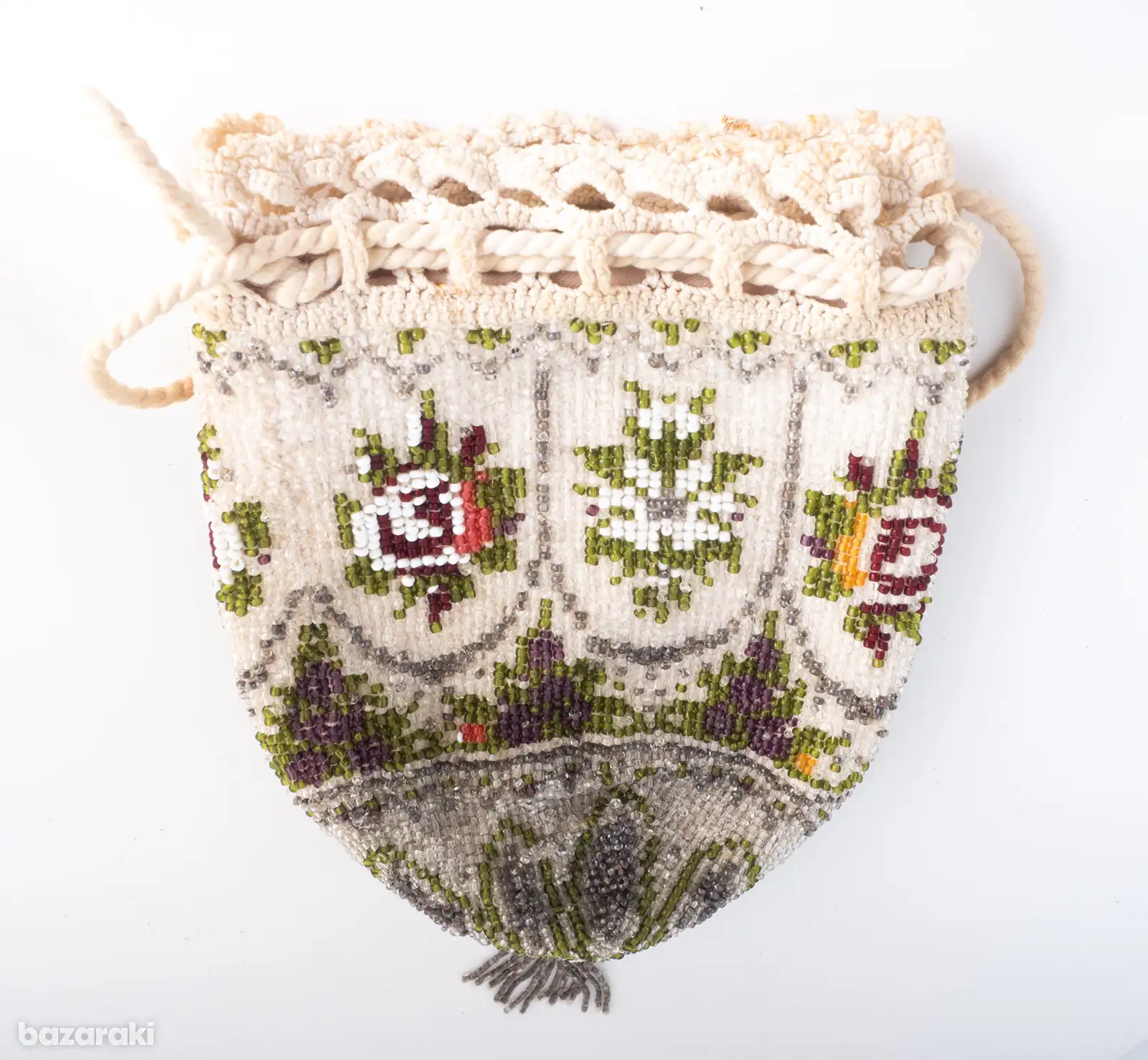
And the result is extraordinary. The upper part of the handbag feels almost like a little garden, filled with flowers and leaves in burgundy, red, white, green and purple. The grey and silvery beads form elegant lines and sweeping arches around the flowers, almost like little windows or decorative frames. Then the design moves downward into richer purple and green forms before opening into a beautiful fan-like pattern of clear, silver-grey and green beads. Finally, everything comes together at the bottom in the delicate tassel of smoky-grey and clear glass bugle beads. The eye naturally travels across the purse, discovering one detail after another, which is remarkable considering how small the handbag actually is.
Around 1900–1915, a woman might have carried a little reticule like this to an evening dinner, a dance, the theatre, a reception or another formal occasion. These small drawstring handbags were not designed to carry very much. She may have placed a few coins, a handkerchief, calling cards or other small personal necessities inside. But the handbag was also part of her outfit. It was something she could hold in her hand that showed her taste and elegance. Imagine an Edwardian woman preparing to leave home in her beautiful dress, taking this little purse with her and watching the glass beads catch the light as she moved. She could never have imagined that the same handbag would still exist more than a century later.
And somehow, it did survive. Today, the purse is more than 100 years old and remains in remarkably beautiful condition. The delicate beadwork has survived across the front and reverse, and the original design remains wonderfully clear. There is a soft yellowish age patina visible in parts of the upper area, giving the older ivory-coloured surface a gentle warmth that feels completely natural for its age. At the same time, the glass beads remain remarkably shiny. The clear beads still sparkle, the greens and reds remain rich, and the darker beads catch the light beautifully. This contrast is part of its charm: the soft patina tells us that time has passed, while the shining glass reminds us of the beauty that has survived.
That is what makes this little handbag so special today. Its beauty is not simply in the glass or the colours. It is in the whole journey — from the old European glassmaking traditions, to the thousands of tiny beads, to the experienced beadworker who patiently turned them into flowers and patterns, to the Edwardian woman who once carried it in her hand, and finally to us more than a century later. The beads have their own tiny variations and handmade character, the design still shows the extraordinary skill of its maker, and the gentle signs of age make it even more personal. It is a very small handbag, approximately 23 cm high including the tassel and 13 cm wide, but it has managed to carry a remarkably large story through time.
More than a hundred years later, the world that created it has disappeared, but the little handbag remains — still delicate, still colourful, still sparkling in the light, and still carrying the memory of the hands that made it.